Prof. Kathryn Weathersby
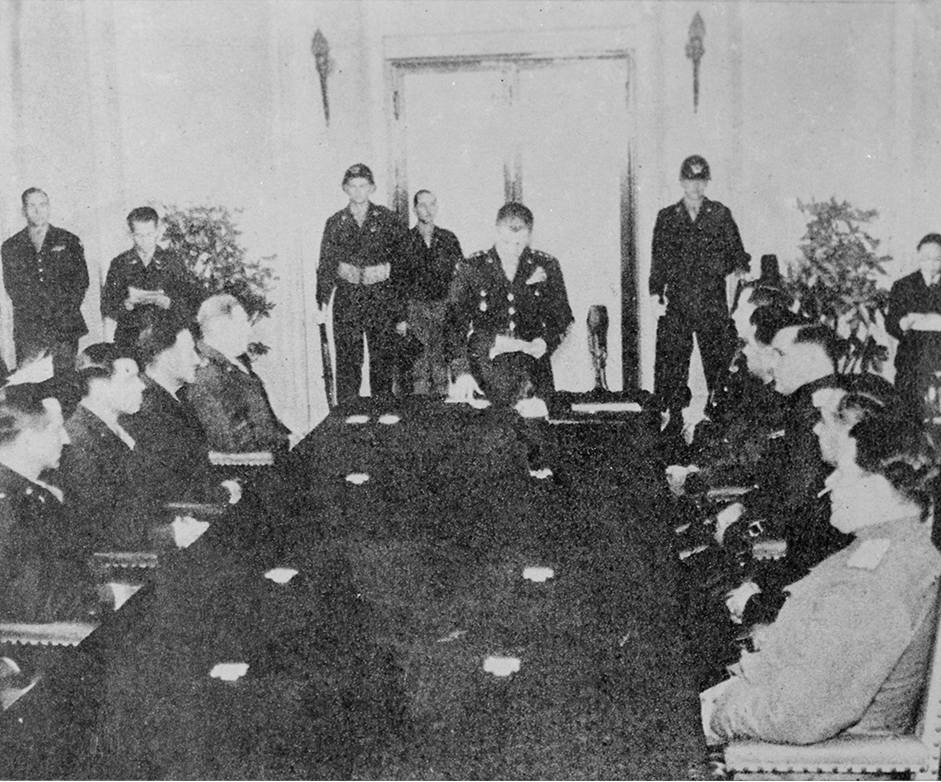
In the previous post we saw the detailed description of the kind of government and society Moscow was determined to create in Korea. The directive to the Soviet delegation at the Joint Commission meetings also specified the process the Commission should follow as it consulted with “democratic parties and social organizations” to create a Provisional Government.
The key point was that the Joint Commission “must not consult with parties and groups that speak out against the decision on Korea of the Moscow Conference of Three Ministers.” As we have seen, when the agreement was announced in January 1946, the Soviet authorities in the North instructed the Korean Communist Party in Seoul to change their position. Instead of denouncing the agreement to create a trusteeship for Korea, as all other parties were doing, the Communist Party would now voice support. Consequently, their demand regarding the consultations would mean that the Provisional Government would be composed only of communists and their “fellow travelers.”
Of course, there was very little chance that the United States would accept this condition. Nonetheless, the Foreign Ministry nonetheless outlined details of the consultation process so that the Soviets could maintain the appearance of carrying out the Moscow Agreement. First, the Joint Commission would propose that “the democratic parties and social organizations express their opinion on the political platform and principles of organization of the Provisional Government and the local organs of power,” the terms outlined in the previous post. Next, “after the Joint Commission receives and studies the opinions of the democratic parties and social organizations on the questions laid out in point “a” they must discuss with them the list of candidates to the Provisional Korean Democratic Government.”
After these discussions, the Joint Commission will create sub-commissions to study the Koreans’ proposals. Moreover, after the consultations in Seoul, the Joint Commission will move to Pyongyang to consult with “democratic parties and social organizations” in the northern zone. The Ministry’s directive ended with instructions to rebuff any US attempt to discuss the economic unification of Korea, since the Soviets wanted to continue to be able to extract economic resources from their zone. If the American delegation raises the issue, the Soviet representatives must “explain that the exchange of goods between North and South Korea will be conducted according to agreement between the commanders of both zones of military responsibility in the form of mutual deliveries.”
In keeping with this directive, when the Joint Commission opened its meetings on March 20, the head of the Soviet delegation, Colonel-General Shtykov, stated that “the task of the US-Soviet Commission is to help the Korean people create a provisional Korean government capable of fulfilling the tasks arising from the democratization and reconstruction of the country. The future provisional Korean democratic government must be created on a basis of wide unification of all the democratic parties and social organizations supporting the decision of the Moscow Conference of Foreign Ministers. Only such a government will be able to abolish entirely the remnants of the former Japanese domination in the political and economic life of Korea, to launch a decisive battle with reactionary anti-democratic elements inside the country, to carry out radical measures in the rehabilitation of economic life, to give political liberties to the Koreans and fight for peace in the Far East. The Soviet Union has a keen interest in Korea being a true democratic and independent country, friendly to the Soviet Union, so that in the future it will not become a basis for an attack on the Soviet Union.”
Unsurprisingly, the Joint Commission deadlocked over the issue of which parties to consult in forming the Provisional Government. The Soviet delegation would not compromise on its demand and the American delegation refused to accept terms that would allow only members of the Communist Party and affiliated groups to participate in the work of the Commission. After repeatedly restating these irreconcilable positions, the Joint Commission adjourned on May 8 sine die.
In the next post we will examine why the Joint Commission reconvened in 1947, and the similar lack of results from those meetings.
[Sources: 13 March 1946. Lozovsky to Molotov. Draft directive to the Soviet delegation at the Joint Soviet/American Commission on the Formation of a Provisional Korean democratic government. Archive of the Foreign Policy of the Russian Federation, Fond 18, Opis 8, Delo 79, Papka 6, Str. 4-11; Foreign Relations of the United States, 1946, Volume VIII, pp. 652-654]
This page is synchronized from the post: ‘(Korean War)The Division of Korea, 1945-1948, Post # 19’