by Katherine Weathersby
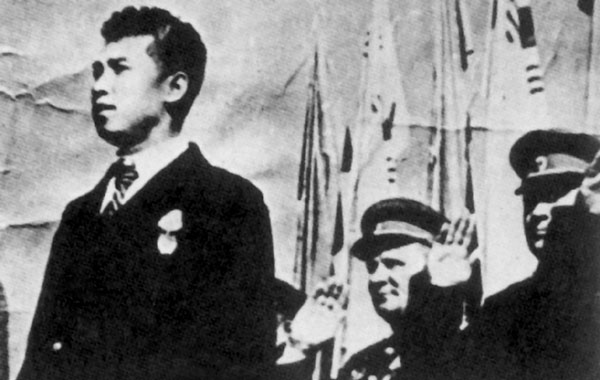
We’ve seen that as the war against Japan ended, the Soviet government was determined to create a reliable security buffer in their zone of Korea, regardless of what might happen in negotiations with the United States over the final political settlement for Korea. Consequently, they moved very quickly to establish the political structures needed to secure long-term control.
Red Army officials first created a Soviet Civil Administration and a separate communist party organization for the North. Then, on October 17 Chistiakov received an order approved directly by Stalin to create a civil government in the first half of November. This government was to be composed of 25-30 persons drawn from the “democratic elements of the Korean population,” meaning people from the lower classes who had not collaborated with the Japanese. It was to have nine departments, paralleling the structure of the Soviet Civil Administration, and must “be under the constant control of the Soviet Military Command.”
Just as communist party members had resisted the formation of a separate party structure for the Soviet zone since doing so suggested a permanent division of the country, non-communist political leaders in the North resisted the creation of a separate governing structure. According to one report, in mid-November the Democratic Party leader Cho Man-sik tried to persuade Kim Il Sung to travel with him to Seoul to establish a central government for the whole country, to prevent the occupation from permanently dividing the country.
Few documents from this period have been released thus far, so we do not know how wide-spread the opposition to Soviet actions was and what actions the Red Army took to deal with it. We do know, however, that by the end of November a Five Provinces Administrative Bureau was formed, based on the people’s committees that Korean political activists had formed throughout the country as soon as Japan surrendered. Soviet authorities placed Cho Man-sik at the head of the pyramidal structure of people’s committees, since at that period Moscow’s policy was to maintain a “united front” with certain non-communist parties. However, Soviet advisers attached to each department of the Bureau had the final voice on all decisions.
Taking action quickly, the Five Provinces People’s Committees approved plans drafted by Soviet advisers to create trusts for the coal mining industry and the electrical power plants, to form a Korean Post and Telegraph Administration, and to divide the railroads into two railway administrations, directed by a North Korean Railroad Administration. To process the financial credits Moscow would extend to North Korea and to issue currency, Soviet officials established a Central Bank, founded on the Pyongyang branch of the Choson Bank.
While the Red Army hastily established governing structures for its zone in October and November 1945, Moscow and Washington continued to negotiate over the control machinery that would be created for Japan. Stalin assumed that if the United States had exclusive power to determine the nature of the future Japanese society and government, the result would be a remilitarized Japan that would again threaten the Soviet Union. Foreign Minister Molotov therefore persistently tried to secure veto power for the Soviet representative in whatever council the allies would establish for the occupation of Japan. The Americans held firm, however, insisting that the Soviet representative would be able to advise the American commander but that the US, as the sole occupying power, would be free to make decisions on its own.
While these negotiations over Japan continued, Moscow refrained from taking any public stand on a political settlement for Korea. They also made sure Korean communists refrained from harsh criticism of the United States. While they criticized a State Department statement that Korea must be placed under trusteeship because her enslavement by Japan had left her unprepared for immediate self-government, Haebang Ilbo declared that “the ideals of the United States, the leader of capitalism, and the Soviet Union, the fatherland of the proletariat, are to be expressed in Korea without contradiction.”
In the next post we will look at how the Soviets and Americans finally reached an agreement on Korea at the Moscow Conference of Allied Foreign Ministers in December 1945 and the reasons this solution would lead to division.
[Sources: Jeon Hyun Soo, “Sotsial’no-ekonomicheskie preobrazovaniia v severnoi Koree v pervye gody posle osvobozhdeniia, 1945-1948”; FRUS 1945, Volume VI; Eric van Ree, Socialism in One Zone, Stalin’s Policy in Korea, 1945-1947 (Oxford, New York, and Munich: Berg Publishers, 1989); Chong-sik Lee, Materials on Korean Communism]
This page is synchronized from the post: ‘(Korean War History) The Division of Korea, 1945-1948. Post # 9’