Prof. Kathryn Weathersby
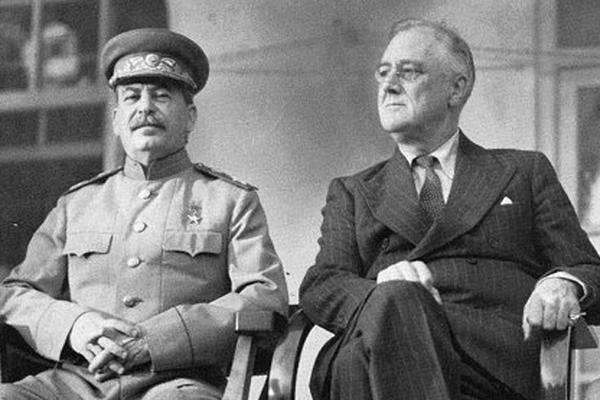
We saw in the last post that Secretary of State Byrnes began the discussion of Korea at the December 1945 Conference of Allied Foreign Ministers with a confused statement about the need for American and Soviet commanders to work out solutions to practical problems caused by the division of Korea into two occupation zones. Foreign Minister Molotov brought that discussion to an end by suggesting that “an examination of the question of a unified administration, trusteeship, and an independent government of Korea, as discussed by President Roosevelt and Generalissimo Stalin, would facilitate the settlement of these practical questions raised in Mr. Harriman’s letter.”
British Foreign Secretary Bevin took up Molotov’s suggestion, asking for a copy of the original agreement on trusteeship. Since there had been only a verbal discussion with no written agreement, Byrnes offered that the US delegation would prepare a paper on the matter for the next meeting. Since it was advantageous to let the Americans be the first to show their hand, Molotov agreed to defer discussion of Korea until the US document was presented.
The proposal the Americans presented the following day stated that “it has been generally understood” that the four-power trusteeship would last no longer than necessary to allow Koreans to form an “independent, representative, and effective government.” The proposal repeated the formula Byrnes had discussed the previous day regarding the creation of a unified administration under the two military commanders before concluding with a formula for trusteeship only slightly less vague than the Yalta agreement.
Acknowledging that “our ideas on the provisions of a trusteeship agreement have not taken definite form,” the US proposed a quadripartite authority that would act on behalf of the United Nations and the people of Korea. In accordance with Article 76 of the United Nations Charter, this authority would exercise the executive, legislative, and judicial powers needed to efficiently administer the country until a free and independent government was established. The authority would consist of a High Commissioner and an Executive Council that would, aside from promoting the progressive political, economic, and social advancement of the Korean people, “establish a popularly elected Korean legislature and an adequate Korean judicial system, all for the purpose of bringing into being an independent Korean Government within a period of five years.”
I would suggest at this point that such an agreement might have worked if the trusteeship partners had been the United States and Great Britain, countries with similar political values and institutions. In fact, Bevin responded favorably to the proposal, suggesting that the matter be referred to specialists for implementation, as the British government would have “no violent conflict with regard to these principles.” However, for the US to propose that it would work together with Stalin’s Soviet Union to promote the “political, economic, and social advancement” of Korea was clearly absurd, given the two countries’ diametrically opposed political and social systems.
American diplomats familiar with the Soviet Union understood well that this formula was not only absurd but also dangerous. The future architect of containment policy, George F. Kennan, who was then serving at the US Embassy in Moscow, believed that the conference should not have been held in the first place, since it was unlikely to produce anything of substance and would instead only cloak with legitimacy the USSR’s imposition of dictatorship in the areas it occupied. Regarding Byrnes’ determination to reach some kind of agreement, on this and other issues on the agenda, in order to gain political advantage at home, Kennan astutely observed that “the realities behind the agreement, since they concern only such people as Koreans, Romanians, and Iranians, about whom he knows nothing, do not concern him. The Russians know this. They will see that he pays a heavy price in the things that are real.”
Kennan recalled later that Molotov “sat leaning forward over the table, a Russian cigarette dangling from his mouth, his eyes flashing with satisfaction and confidence as he glanced from one to the other of the foreign ministers…He had the look of a passionate poker player who knows that he has a royal flush and is about the call the last of his opponents.”
In the next post, we will see precisely how, with regard to Korea, Foreign Minister Molotov exacted a “heavy price in the things that are real.”
[Sources: George F. Kennan, Memoirs: 1925-1950; Foreign Relations of the United States, 1945, Volume II]
This page is synchronized from the post: ‘(Korean War History) The Division of Korea, 1945-1948. Post #13’